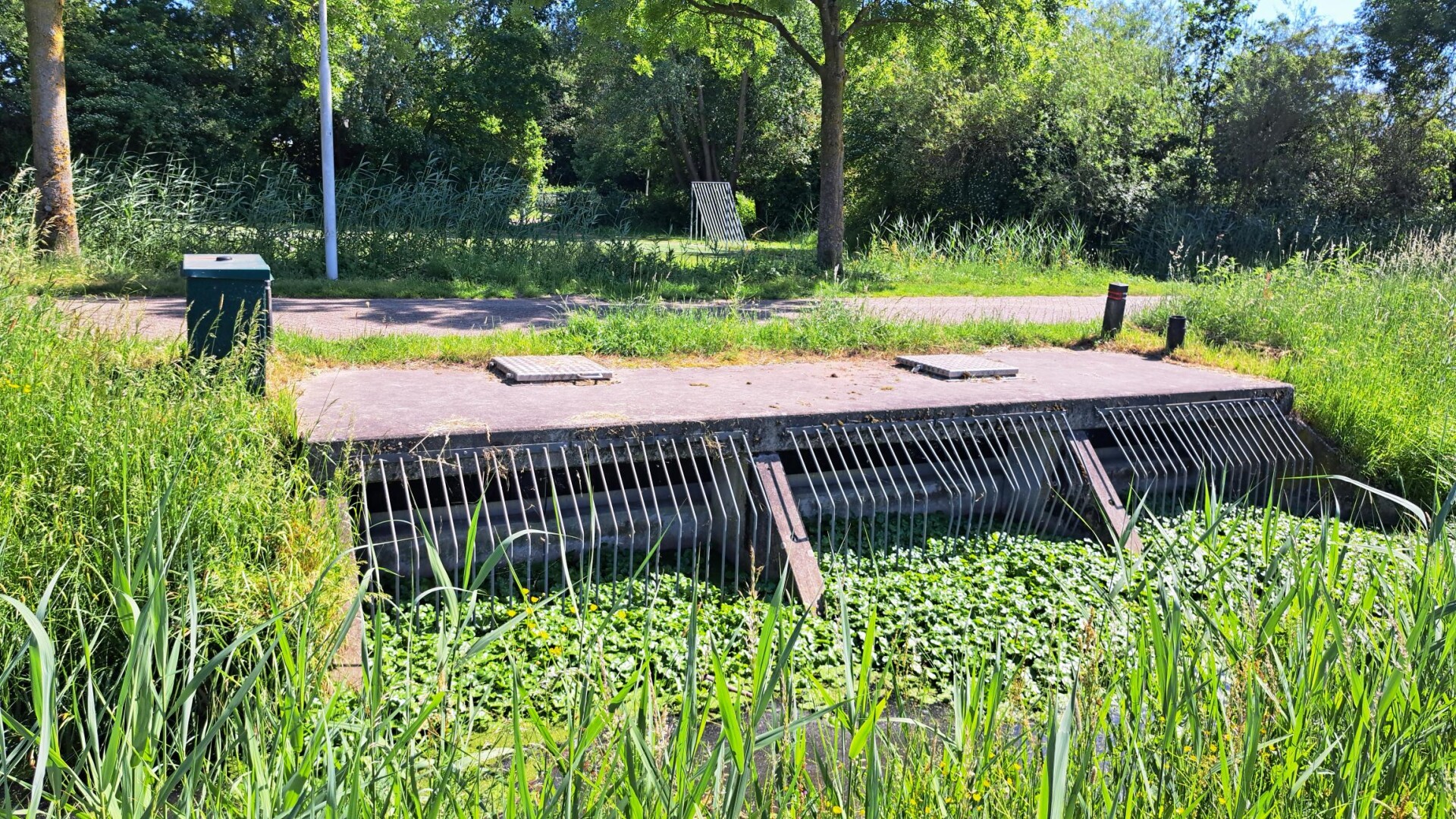
One of the investigated sewage discharge points | Photo Koen Dorn/Aa en Maas Water Board

One of the investigated sewage discharge points | Photo Koen Dorn/Aa en Maas Water Board





Discharges from sewer overflows (combined sewer systems) and stormwater outlets (separate sewer systems) (hereinafter collectively referred to as ‘sewer discharges’) can have a negative impact on water quality. Sewage discharges can lead to locally elevated concentrations of nutrients and toxic substances, which may persist even after the discharge due to continued release from settled sewage sludge. In addition, these discharges often lead to lower oxygen levels, as sewage contains little oxygen and the settled sewage sludge needs oxygen to break down the abundant organic matter. The resulting oxygen depletion, as well as eutrophication and toxicity, can make the water unsuitable (or even more so) for macrofauna.
To determine the impact of sewage discharges on macrofauna, an extensive monitoring programme is ideally required for each overflow and stormwater outlet. Such a monitoring setup is costly and difficult to plan, as sewage discharges only occur during or after heavy rainfall. Nevertheless, the water board has several decades’ worth of monitoring data on macrofauna (for example, due to monitoring requirements under the Water Framework Directive, WFD) as well as information on the location, duration and volume of sewage discharges.
Can this data be used to determine the effects of sewage discharges on macrofauna? And at what distance from the discharge point does a potential impact occur, how long does this impact last, and which characteristics of the discharge or the receiving water influence this impact? To answer these questions, a statistical approach was adopted in which the effect of the discharges on macrofauna was isolated from the many other factors that influence macrofauna.
Scope
In our study, we focused on two types of discharges. Discharges from combined sewer systems (via an overflow, where the discharged water consists of wastewater and rainwater), and discharges from separate sewer systems (via an outlet, with water consisting of rainwater runoff). These two types were considered in conjunction, as it is impossible to differentiate between their individual effects. This is due to the geographical proximity of both types of discharge, combined with the limited spatial resolution of the macrofauna data.
In terms of aquatic life, this article focuses on macrofauna. Aa en Maas would also have liked to assess the impact of sewage discharges on fish and aquatic plants, but there was insufficient data available to do so.
Method
We used data collected between 2010 and 2019, during which time over 1,000 macrofauna samples were collected at 235 sites within the management area. This biological data (including abundance and species richness) was linked to information on approximately 725 sewage discharge points. For these discharge points, a tool developed by Aa en Maas (the ‘overflow estimator’) was used to estimate the pollution load of the discharges, as an indication of the burden on the water system. The tool calculates this pollution load (depending on the duration, frequency and intensity of the discharge) based on precipitation (rain radar), the amount of paved surface area and the characteristics of the sewer system.
Generalised Additive Models (GAM) were used to determine the effect of sewage discharges on macrofauna [1]. These statistical models make it possible to isolate the effect of discharges as accurately as possible by correcting for other factors that influence macrofauna, such as hydrology (whether it was a wet or dry year), the timing of the measurement during the season (whether certain species have already emerged or not) and the location of the measurement site (conditions that result in consistently better or poorer water quality, such as surrounding agricultural land, flow velocity, shading and meandering) [2] [3]. Additionally, these models were used to determine the downstream distance over which macrofauna is affected by sewage discharges.
Far-reaching effects
The analysis clearly shows that sewage discharges have a negative impact on macrofauna. On average, fewer macrofauna are found near discharge points (lower abundance), and species richness is also lower (Figure 1). The Ecological Quality Ratio (EQR), a measure of ecological status [4], is therefore significantly lower in the vicinity of discharge points.
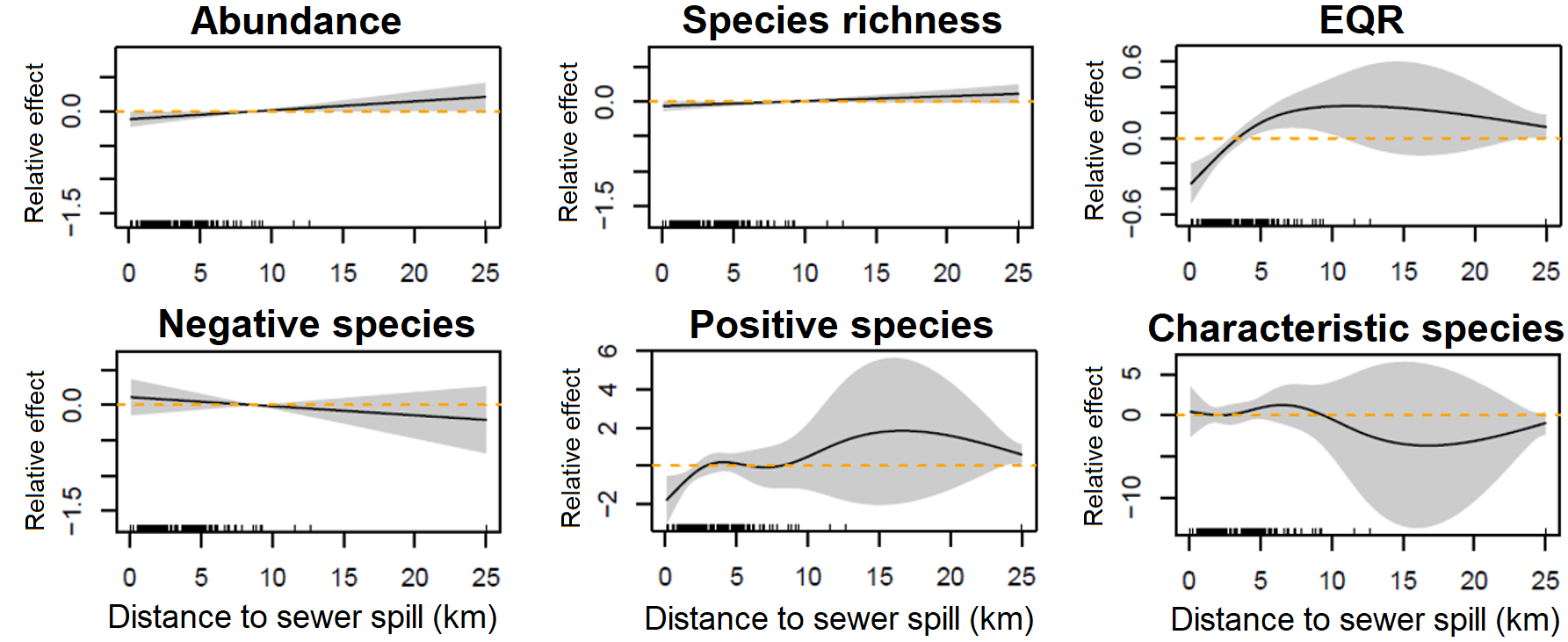
Figure 1. Relative effect of the minimum distance between the macrofauna monitoring point and the sewage discharge point (in km) on macrofauna in terms of abundance, species richness, Ecological Quality Ratio (EQR) and the number of negative-, positive- and characteristic indicator species.
There is also a clear link between sewage discharges and the occurrence of what are known as positive-, negative- and characteristic indicator species. These are macrofauna that have been designated as water quality indicators under the WFD [5]. Positive indicator species indicate a healthy, well-functioning ecosystem, whereas negative indicator species indicate poor water quality and/or a high level of (oxygen-depleted) sludge. Characteristic species are found exclusively in areas with good water quality and are key indicators of the EQR.
What stands out is that positive indicator species are less common in the vicinity of the discharge points. Conversely, negative indicator species are more commonly found near discharge points. This negative impact appears not to be limited to the immediate vicinity of the discharge point. The impact is still noticeable within an average distance of 5 kilometres downstream, with a peak within the first 3 kilometres. This means that sewage discharges can have not only a local but also a far-reaching impact on the macrofauna of a watercourse.
It also appears that the effect is more pronounced in waters that flow slowly and/or have a low discharge. Under these circumstances, the released sewage discharges remain in the water for a longer period, and a greater proportion of the sewage sludge settles locally, both resulting in macrofauna being exposed to pollutants for longer and/or in higher concentrations. We also see a greater impact on macrofauna in watercourses where sewage discharges have higher pollution loads.
Sewage discharges mainly occur in built-up areas. We therefore analysed whether the observed effect of sewage discharges on macrofauna is actually caused by the discharges and not by the built-up area itself. The analysis shows that the distance from built-up areas does not appear to have a significant impact on macrofauna. This implies that additional pollution in urban areas (caused, for example, by pollutant run-off from roads) has a lesser effect on macrofauna (or at least no significant effect) compared to sewage discharges.
Based on an average impact radius of 5 kilometres, we have mapped out in which parts of our water system macrofauna are affected by sewage discharges (Figure 2). For WFD water bodies, 68 percent of the total area lies within 5 kilometres of a discharge point (sections shaded in red). For non-WFD water bodies, this figure is 33 percent (sections shaded in orange). In short, a significant proportion of the water system is potentially adversely affected by sewage discharges. It should be noted that the impact radius – 5 kilometres on average – can vary significantly depending on the discharge location.
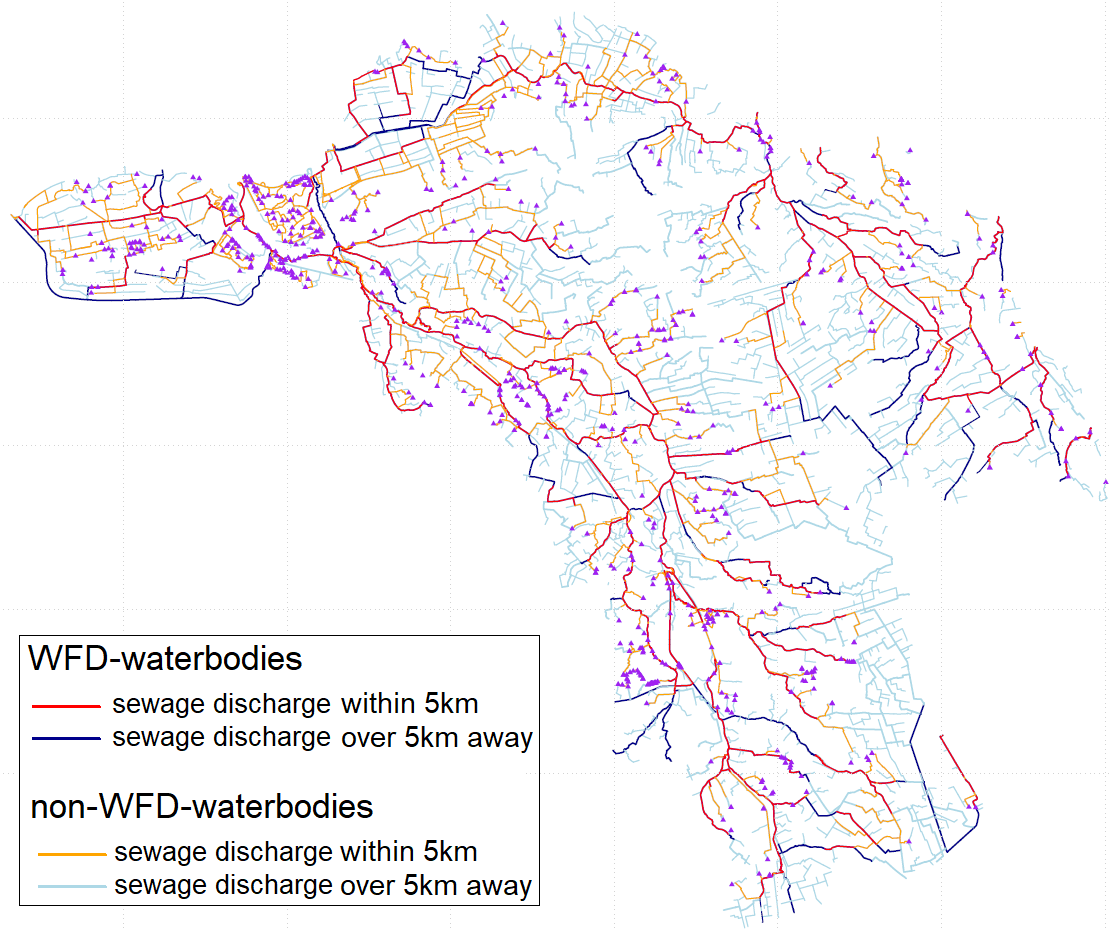
Figure 2. Surface water (red and orange) where macrofauna is likely to be affected by sewage discharges, as it is located within 5 km downstream of a discharge point (red: WFD water bodies, orange: non-WFD water bodies). Routes marked in blue and purple are more than 5 km from a discharge point.
Conclusions and recommendations
This study provides an indication of the ecological impact of sewage discharges. Despite the limitations of the current monitoring network – such as the low sampling frequency and the lack of strategic sampling sites in relation to discharge points – it has been possible to use existing data and statistics to give a picture of the impact of sewage discharges on macrofauna.
The most important conclusion is that sewage discharges have a demonstrable negative impact on the ecological quality of watercourses, extending several kilometres downstream. This effect is most pronounced in slow-flowing waters and watercourses that have high sewage pollution loads. For water authorities, this means that the impact of sewage discharges warrants attention not only at a local level, but also at the level of the wider water system.
The macrofauna monitoring network used in this study (regular measurements for the WFD) is not designed to assess the impact of sewage discharges on macrofauna. Targeted macrofauna monitoring using a BACI (Before-After-Control-Impact) approach around specific discharge points could help to gain a more accurate picture of the effects. Expanding the dataset with recent measurements and collaborating with other water boards could also lead to more robust conclusions.
Important measures to minimise the ecological impact of sewage discharges include reducing the load, frequency and occurrence of such discharges. The first step in this process is for municipalities and water boards to share their data on the impact of sewage discharges on the receiving water system. Based on a shared understanding, we can explore which measures are effective in mitigating the negative effects of sewage discharges.
One final remark: in addition to sewage discharges, several other factors can affect macrofauna, such as poorer water quality caused by agricultural run-off or industrial discharges, or unfavourable living conditions resulting from low flow rates, insufficient shade or a lack of meandering. However, these factors have been deliberately excluded from this study. The effect of these factors was accounted for in the statistical model, making it possible to study the effect of sewage discharges in isolation. An analysis of the relative negative impacts of other stress factors on macrofauna should be carried out as part of a comprehensive study.
This study by the Aa en Maas Water Board investigated the ecological effects of sewage discharges on macrofauna. To this end, data from more than 1,000 macrofauna samples was linked to approximately 725 discharge points from sewer systems. The effect of sewage discharges was isolated from other environmental factors using Generalised Additive Models (GAM). The analysis shows that sewage discharges have a clear negative impact on macrofauna, with a decrease in abundance, species richness and EQR scores near to discharge points. Positive- and characteristic indicator species are being displaced, whilst negative indicator species are becoming more common. Significant ecological effects are observable up to an average of 5 kilometres downstream, particularly in systems with low discharges and/or little flow. A large part of our water system lies within this sphere of influence. The study emphasises the importance of reducing the load, frequency and occurrence of sewage discharges.