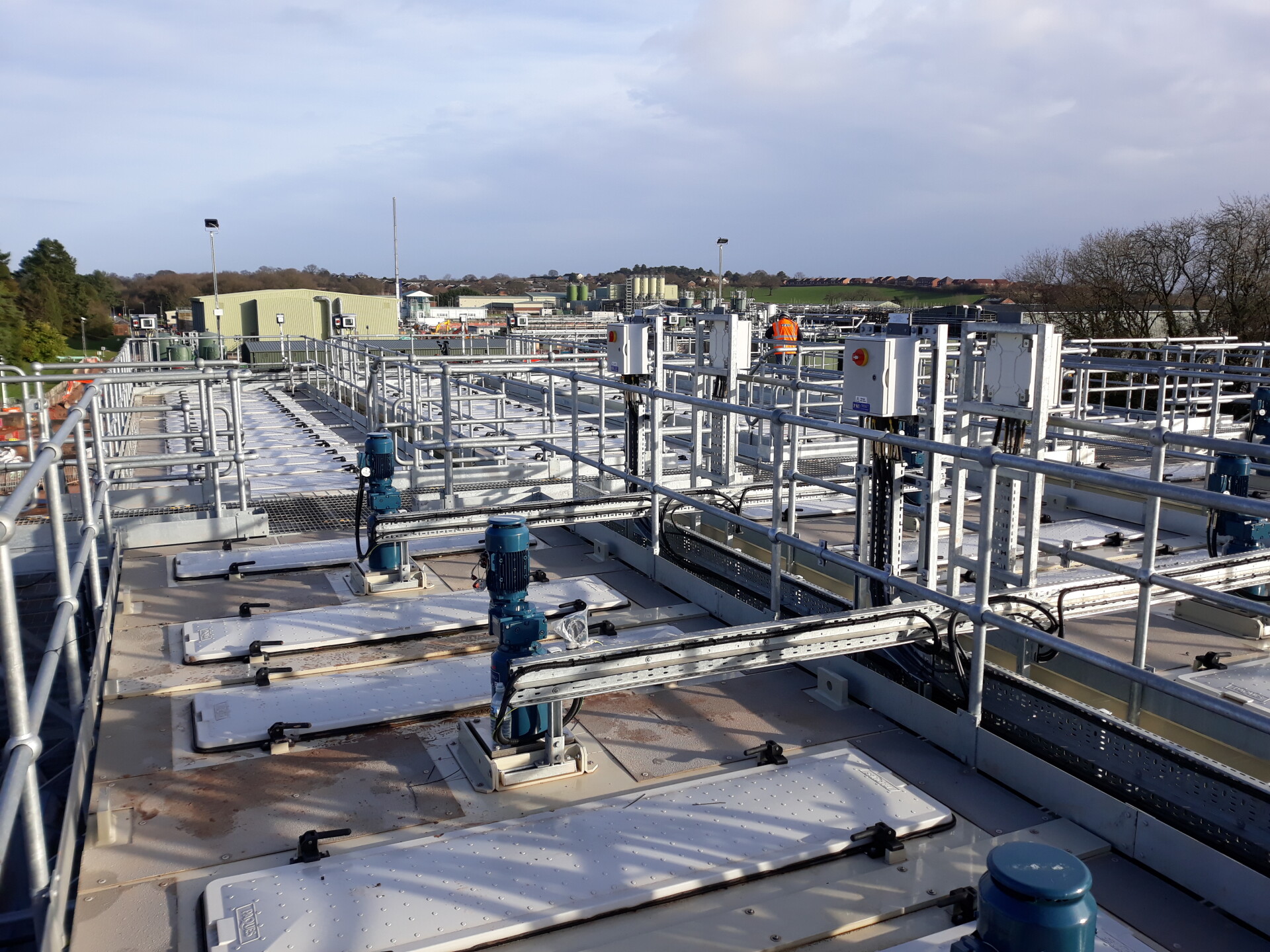
Flocculation tanks at a site for drinking water production | Photo: Paques

Flocculation tanks at a site for drinking water production | Photo: Paques





To remove suspended particles – ranging from submicron colloids to coarse visible clays – from (waste)water, industries worldwide make use of flocculants. By attracting and aggregating floating particles into larger clumps, flocculants make particulate matter separable from the aqueous phase. Commercial, synthetic flocculants are often polymers based on fossil fuels, such as polyacrylamide (PAM) or polyethyleneimine (PEI). The presence of these polymers in the sludge and filter residues that remain after flocculation processes, is increasingly linked to environmental risks, such as the release of potentially toxic compounds, or the formation of microparticles that may accumulate in sediments and soils. For instance the application of PAM-containing granulite for the shallowing of deep lakes in The Netherlands has raised concerns over the potential release of acrylamide, the monomer of PAM and an environmentally hazardous substance. Despite these concerns, synthetic flocculants are widely applied at large scale, mostly due to their high efficiency and their cost-effective production.
In the quest for sustainable alternatives, a potential ally may be found in microorganisms that live in communities known as biofilms. In biofilms, microbes can have synergistic interactions, shed themselves from toxic environments or ensure survival in a favorable niche [1]. Microorganisms create these biofilms through the excretion of various exopolymers (Extracellular Polymeric Substances, EPS) that are able to aggregate into soft gels. The ability of EPS to aggregate often comes from distinct polymer properties, such as a multitude of cross-polymer bonds and -interactions. Hence, EPS often have a high charge density and (very) high molecular weights – just like synthetic flocculants.
Biodegradable flocculants
The potential of using this microbial ability of EPS synthesis for the production of sustainable flocculants, was recently demonstrated – for the first time – by Wetsus, Wageningen University, Paques Global and Pentair X-Flow [2]. By steering the process conditions, it appears to be possible to redirect bacteria in organics-rich wastewater treatment to produce less CO₂ and sludge, and more EPS (mostly polysaccharides and proteins) instead. This early work, led by H. Temmink and his team, showed that limiting macronutrients in bioreactors enables microbial communities to convert up to 54% of organics (chemical oxygen demand, COD) into EPS while treating synthetic wastewaters with different salinity [2]. These EPS effectively flocculated clay particles, thereby combining industrial wastewater treatment with the production of ‘natural flocculants’ (Figure 1).
These results confirmed that macronutrient limitation is crucial for the overproduction of high molecular weight EPS, and that sludge residence time (SRT) must be kept short (1.5 – 3 days). For example, shortening the SRT from 6 to 3 days can triple EPS recovery [3]. These principles apply to various inocula, although the time needed to reach maximum production may vary [3]. Long-term stability (>100 days, ~50 SRTs) and successful application on real wastewaters have been demonstrated in semi-pilot bioreactors, increasing confidence in the process viability [4]. As expected, real/complex streams yield somewhat less EPS compared to pure substrates (e.g. 30% COD-recovery from glycerol-rich wastewater vs. 42% from pure glycerol). Nevertheless, this is still a substantial amount of valuable flocculant (2.1 g EPS per liter per day) that would otherwise be lost in conventional wastewater treatment [4].
The reactor design concept for this process undergoes continuous development. Membrane bioreactors (MBRs) were initially proposed for the generation of clean effluent and retention of EPS and microbes. However, bioreactors without sludge retention – airlift chemostats, applied at Wetsus – have shown promising EPS yields and simpler operation, avoiding fouling issues from the highly viscous, mixed liquors [4]. Recent semi-continuous processes developed at Paques seem to be effective systems too, for improved control of viscosity and, therefore, oxygen transfer efficiency. Hence, the choice of bioreactor design depends on operational parameters, aeration energy costs and the concentration of organics in the wastewater.
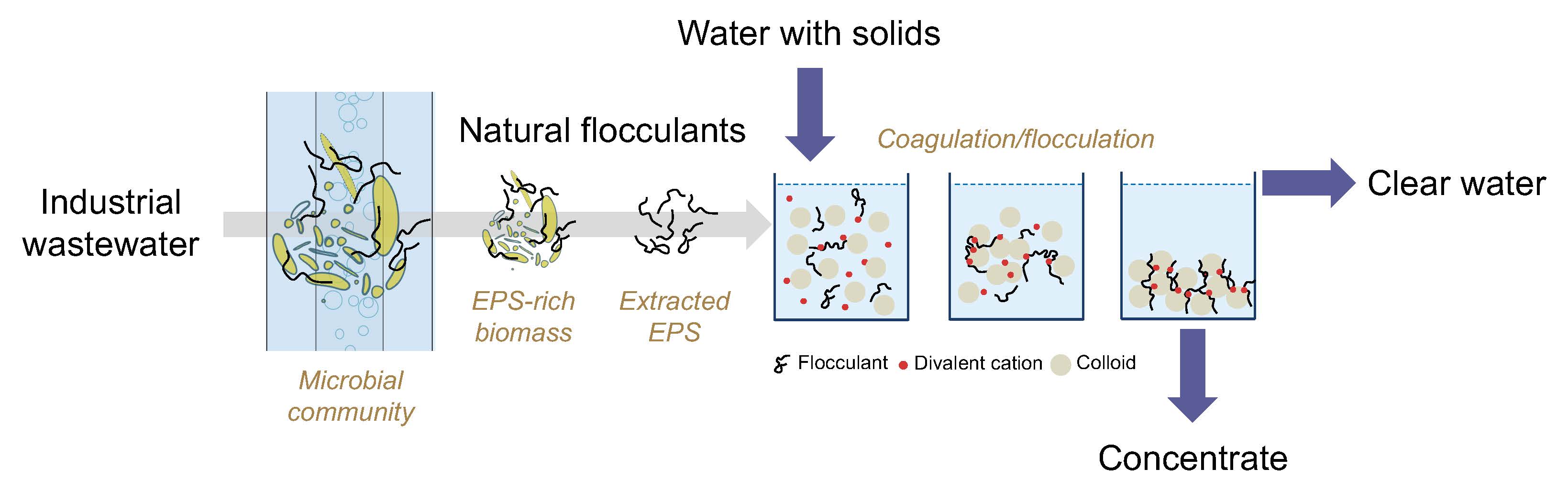
Figure 1. Production process for microbial flocculants, to replace synthetic anionic flocculants in (waste)water treatment.
In the microbial EPS production process we investigated reaction conditions steering toward polymer properties that are key to flocculation performance. In particular the molecular weight and charge density strongly determine the potential of polymers to attract and aggregate suspended matter. Thus far we have been focusing on the production of anionic (negatively charged) EPS. Extracted EPS, produced from glycerol in airlift chemostats, had a high molecular weight (1 – 2.3 MDa) and net negative charge (1.75 – 4 meq/g) [3,4]. EPS produced in a semi-continuous reactor had a similar molecular weight (1.4 – 2.6 MDa) and negative charge (1.1 – 4.2 meq/g). These characteristics were maintained when using glycerol-rich wastewater from biodiesel production (2.4 – 2.5 MDa; 1.8 – 2.6 meq/g) [4].
Given the nutrient-limiting conditions applied in the bioprocess, microbial growth is restrained and the produced biomass is highly enriched with EPS. This provides the possibility to apply the EPS-rich biomass directly as an inexpensive flocculant. If, however, a higher purity is desired, the EPS needs to be extracted from the biomass and potentially further purified.
To test the flocculation activity of untreated EPS-rich biomass and extracted EPS, both were applied to industrially polluted water samples and model clay dispersions resembling particles commonly present in natural surface water. In the experiments with model clay, calcium was added as a coagulant to bridge the negative charges of both EPS and clay particles. Both untreated biomass and extracted EPS displayed a high flocculation potential, with different dose-dependent trends depending on the bioreactor type and the feedstock used (Figure 2A). Generally, lower amounts of extracted EPS suffice to achieve optimal results, since the polymeric EPS chains are more available after extraction compared to untreated biomass.
Wastewater from dredging and food industries
Dredging activities in lakes, harbors and at sea generate massive volumes of water polluted with sediment particles, which require treatment via coagulation-flocculation for returning particle-free water back to the aquatic environment. Experiments with water samples from dredging activities confirmed the flocculation potential, albeit only when applying extracted EPS (72% reduction of turbidity), while EPS-rich biomass did not show flocculation activity (Figure 2B). Washing water from the potato-processing industry was effectively treated to remove soil particles, with extracted EPS performing comparably (85% reduction of turbidity) to the synthetic flocculant PAM (83% reduction of turbidity), although this required slightly higher EPS concentrations (Figure 2B). In this case, some flocculation was observed with EPS-rich biomass, but with only 30% turbidity removal. Both in dredging and potato processing, the use of biodegradable flocculants would open doors to environmentally safer routes for recycling and disposal of flocculated sediments, and reduced treatment costs.
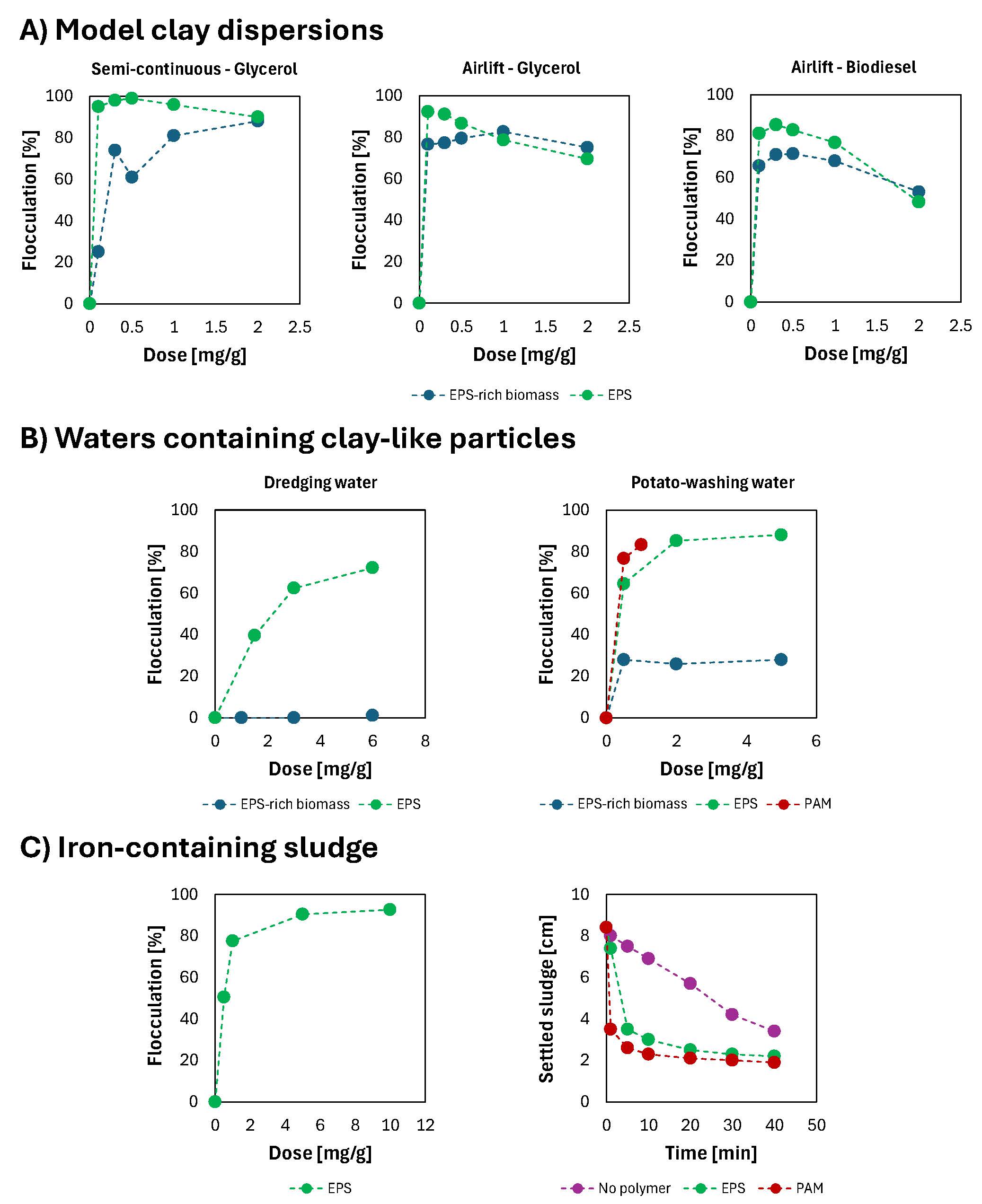
Figure 2. Flocculation results with model clay dispersions (A), clay-like particles in wastewater from the dredging and potato-processing industry (B) and iron-containing sludge from drinking water production (C). Model clay experiments used a mixture of kaolinite (1.5 g/L) and montmorillonite (1.5 g/L). Total suspended solids were 0.4 g/L in dredging water, 5.6 g/L in potato-washing water, and 3 g/L in iron sludge from drinking water production. Calcium (100 mg/L Ca2+) was added in all experiments, except in those with iron-containing sludge. In (B) and (C), the applied EPS were produced in the semi-continuous reactor. Flocculation is expressed as turbidity removal compared to only the use of a coagulant.
Iron sludge from drinking water production
During the preparation of drinking water from groundwater, typically a large amount of iron-containing sludge is generated. This sludge is usually thickened with PAM to achieve a higher solids content, thereby limiting disposal costs as well as CO2 emissions from sludge transport. Our results show that extracted EPS are able to flocculate and thicken this sludge, removing above 90% turbidity. Addition of a coagulant was not necessary, probably because the iron particles (iron(III) oxide hydrate) mostly carry neutral charge at circumneutral pH. Also, EPS appeared to be able to thicken the iron sludge at rates comparable to PAM (Figure 2C).
Technology readiness
On the ladder of technology readiness levels (TRL), a scale of 1 to 9, our process for the production of EPS from waste(water) is validated at TRL 5 (semi-pilot scale) [5], while their application as flocculants is at TRL 4 (lab-scale). Further development of the technology requires pilot-scale demonstration and improvement of cost-effectiveness such that EPS production may compete with the production of synthetic flocculants. Also we are exploring several routes to obtain cationic (positively charged) flocculants for dewatering applications.
It is clear that the microbial production of EPS holds promise to produce natural, non-toxic flocculants. Transitioning to sustainable flocculants, however, requires more than the development of technology alone. A successful transition of cheap but hazardous ‘fossil’ flocculants to non-toxic, circular alternatives, also calls for the creation of regulatory drivers that stimulate this transition, and the assignment of an end-of-waste status to biopolymers derived from waste(water).
Flocculation processes worldwide often rely on fossil-based polymers with uncertain effects in the aquatic environment. Circular and safe alternatives can be obtained by treating certain wastewaters with naturally occurring bacteria. These natural flocculants turn out to be effective for the treatment of wastewater from dredging activities and potato processing, and iron-containing sludge from drinking water production. Further research is needed to demonstrate this technology under industrial conditions and to expand potential market applications.